.png)
What our 2024 Individual Member Survey Taught Us: Part 2
- vic
- Oct 31, 2025
- 3 min read
Understanding Diagnosis Experiences: What Our Members Told Us

As our new GAIN survey opens for 2025, we’re looking back at one of the most revealing areas of last year’s data: the experiences of our members with diagnosis and self-identification.
Diagnosis, and how employers should support neurodivergent colleagues who want it, is a common topic raised in conversations with our corporate members. How employees come to understand and identify their neurodivergence shapes not only their own sense of identity, but also how they’re supported (or not) in the workplace.
At GAIN, we follow the neurodivergent community standpoint that self-diagnosis is valid. For many, barriers such as cost, waiting lists, stigma, or inaccessible healthcare systems make formal diagnosis difficult or even impossible. This year, we wanted to learn more about how those experiences play out across our community.
What the Data Shows
In our 2024 survey, 48% of GAIN members reported having a formal diagnosis, and 11% were in the process of seeking one. 22% identified as self-diagnosed only, while another 19% had both formal and self-identified experiences (for example, someone formally diagnosed with ADHD who suspects they are also autistic).
Perhaps most strikingly, 90% of those with any diagnosis received it in adulthood. The vast majority of GAIN members are late-diagnosed or late-identified, many after helping a child or loved one through their own diagnostic journey.
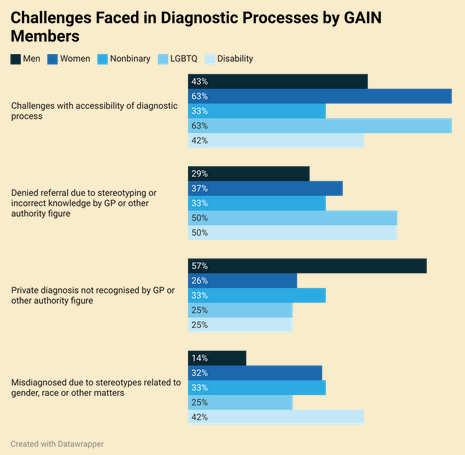
For those who pursued diagnosis, the process was rarely straightforward. Over 70% reported facing barriers, with accessibility of the diagnostic process emerging as the most significant challenge. Accessibility issues were cited by 57% of all respondents, including 63% of women and 43% of men.
While our current data doesn’t yet provide statistically reliable comparisons across ethnicity, we know from external research, such as Dr Vivian Okoye’s work, that Black children, for instance, experience significant delays and higher rates of misdiagnosis. We hope that, with higher participation rates in our survey, we can supplement and amplify the evidence needed to change this.
What We’re Learning
Even with a relatively small sample, it’s clear that barriers to diagnosis are widespread, affecting people across all genders, sexualities, disabilities and ethnicities. This underlines one of the reasons why it is vital that employers not use diagnosis, medical documentation and doctor's notes as a prerequisite for support.
In our 2024 survey report, our operations manager Bea Richardson spoke candidly about the power of self-diagnosis as a tool for self-understanding and empowerment.
“Self-diagnosis hasn’t come without problems... but it has enabled me to empower myself through understanding how my brain works and the best approach to my work life, and in turn, empowering me to thrive.”
Diagnosis should never be the gatekeeper for adjustments or flexibility. Whether someone has a formal report or has come to recognise their neurodivergence through self-reflection and research, their identity and needs are valid. And what's more, they are protected under the Equalities Act 2010, as well.
Why It Matters for Organisations
For employers, the implications are significant. In the UK, the Equality Act 2010 does not indicate a requirement for formal diagnosis to be entitled to reasonable adjustments.
Companies should ensure that diagnosis is not treated as a prerequisite for adjustments, accommodations or inclusion. Instead, flexible and person-centred support should be the norm, not the exception. Wherever possible, organisations should adopt universal design principles, building flexibility, accessibility and inclusion into their culture, processes and environments so that fewer people need to “ask” for adjustments at all.
At a practical level, we also recommend that employers invest in employee benefits packages that include private medical insurance (PMI) with access to diagnostic assessment pathways. Private diagnosis can be prohibitively expensive for individuals, while NHS waiting lists can stretch into years. Offering PMI benefits that include neurodivergent assessment options can be a meaningful, tangible way for employers to reduce barriers and show genuine commitment to neuroinclusion.
Looking Ahead, and Getting Involved

Our findings from 2024 have given us invaluable insights into how diagnosis, identity and accessibility intersect. But to truly understand these patterns, and the experiences behind them, we need more voices, more stories, and a larger dataset.
We’re deeply grateful to everyone who took part last year. Your honesty and openness have helped move the conversation forward. Now, with our 2025 survey live, we’re inviting you to help us go further. The more people who take part, the deeper we can explore these themes, and the stronger our evidence becomes for change.
If you’re part of the GAIN community or the wider neurodivergent community, please take part in this year’s survey and share it with others who might like to contribute. Together, we can continue to push for understanding, accessibility and equity for all.

Comments